Today, the rules of digital visibility are changing very fast. And we as marketers can no longer rely only on traditional SEO methods. Today, you need a three-layered approach where –
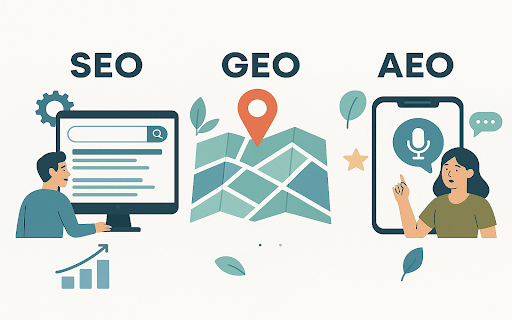
- SEO → Optimizes your website to rank on search engines (SERPs).
- AEO → Structures content to appear as direct answers in snippets, voice search, and AI assistants.
- GEO → Ensures your brand gets cited by generative AI engines like ChatGPT, Gemini, or Bing Chat.
- AIO → Optimizes all brand assets (text, voice, video, entities) for discoverability across AI-driven ecosystems.
And when all of these happen together, you can have a new marketing stack where there’s growth and visibility!
What You Must Know About SEO, GEO, AEO & AIO?
Today, online search patterns have changed so much that even experts from Search Engine Land emphasize that visibility now depends on multiple layers of optimization.
The rise of voice search, zero-click answers, and AI-driven summaries is dominating the search market! And in such scenarios, the definition and roles of SEO have changed as GEO & AEO are emerging.
Here’s a quick breakdown of all three –
Though Search Engine Optimization (SEO) is the foundation of online marketing, its impact has started to decline in “zero-click” environments where users get answers directly on the search page.
According to Semrush, SEO should now be seen as the base layer of discoverability, not the full strategy.
Lately, Answer Engine Optimization (AEO) has emerged as search engines and assistants like Google’s featured snippets, Siri, Alexa, and ChatGPT’s “overview” answers with direct, conversational responses to user queries. It looks something like this –

On the other hand, Generative Engine Optimization (GEO) is a newer and advanced version of where you need to structure content in a way that it gets cited by large language models (LLMs) such as ChatGPT, Bing Chat, and Gemini.
And unlike SEO or AEO, GEO requires brands to demonstrate authority, trustworthiness, and freshness so AI engines view them as credible sources when generating responses.
According to Contently, GEO is not just about keywords but about aligning with how AI curates and summarizes knowledge, which means using citations, expert insights, and structured references throughout your content.
Beyond all of these, there is Artificial Intelligence Optimization (AIO), which is the newest and broadest layer. It focuses on optimizing your brand’s entire digital footprint – text, images, video, voice, and metadata – for AI ecosystems.
Why GEO AEO & AIO Matter Now?
Lately, if you have been wondering what’s the reason behind this rapid shift towards GEO and AEO, here are the factors that are driving this change –
- Zero-click searches: More than half of Google searches end without a click.
- AI-first search: People now ask ChatGPT and Gemini instead of Googling.
- Trust factor: Brands cited in AI engines gain authority fast.
- AIO expansion: As AI assistants move beyond text into video, audio, and multimodal answers, brands need to optimize all forms of content to remain relevant.
Moreover, Gartner projects that by 2026, 25% of people will use generative AI as their primary search tool, making GEO and AEO critical for survival.
Key Differences: SEO vs AEO vs GEO
Here’s a quick table that outlines the difference between the SEO, AEO, and GEO.
|
Strategy |
Objective | Content Approach | Primary Platforms | Success Metrics |
Expert Insight |
| SEO | To be visible in search engine results (SERPs) | Online research, Keywords, backlinks, technical SEO, long-form blogs | Google, Bing | Organic traffic, rankings, CTR | Still foundational, but losing dominance as zero-click searches grow (Semrush) |
| AEO | Win direct answers from answer engines | Concise Q&A, schema markup, voice-search optimization | Google snippets, Siri, Alexa, Bing AI overview | Featured snippet wins, voice mentions | Requires natural language alignment and factual precision (Search Engine Journal) |
| GEO | Be cited by generative AI models | Authoritative content, statistics, references, citations | ChatGPT, Gemini, Bing Chat, Perplexity | AI citation mentions, share of voice in AI outputs | Relies on credibility + freshness to be surfaced by AI engines (Contently) |
| AIO | Optimize brand presence across AI ecosystems | Entity-based content, semantic structuring, multimodal readiness | All AI-driven platforms (LLMs, voice, vision AI) | Accuracy of brand representation, entity inclusion in knowledge graphs | AIO is emerging as the umbrella discipline shaping future discoverability (ClickSlice) |
Now that you have a fair understanding of what SEO, AEO, and GEO are, while understanding their differences too, let’s learn more about the application and when to use them!
When and How to Use SEO, AEO, GEO & AIO?
Now, if you intend to get the maximum branding benefits from SEO, AEO, and GEO – here’s how you can get there!
SEO – The Foundation Layer
When to use: When you want to appear on search engine result pages (SERPs).
How SEO is done:
- Conduct keyword research (Ahrefs, SEMrush).
- On-page optimization (title tags, meta, H1s).
- Build backlinks and maintain strong site performance.
AEO – The Answer Layer
When to use: When you want to appear on the search engine AI overviews.
How AEO is done:
- Write concise 40–50-word answers under Q&A subheadings.
- Use structured data (FAQ schema).
- Keep tone conversational for voice devices.
GEO – The AI Layer
When to use: When you want to appear in the To gain visibility in ChatGPT, Gemini, and Bing Chat.
How GEO is done:
- Publish authoritative content with stats, expert quotes, and references.
- Design structured posts with logical headings – making it easy for AI to parse.
- Keep content fresh by updating regularly with new insights.
AIO – The Future Layer
When to use:
When you want your brand to stay visible across AI-driven ecosystems and even multimodal AI platforms (image/video search).
How AIO is done:
- Optimize entities & knowledge graphs by ensuring your brand, products, and people are well-structured in the data sources AI uses.
- Use semantic and NLP-friendly content by writing with natural language and structured meaning so AI can parse context easily.
- Adapt multimodally by going beyond text by optimizing video, images, and audio for AI indexing.
- Update consistently by keeping content fresh and factually correct to maintain AI trust.
To get the maximum output for your online visibility, it’s always recommended to start broad with SEO by writing a long-form blog to cover a topic. And on top of that, add FAQs and optimize for snippets and voice to appear in AI overviews, and finally, back that with data and citations to make sure AI engines reference your content.
Tools & Resources Needed for GEO, AEO, and AIO

Now, to appear in the generative engine (ChatGPT, Gemini, Bing Chat, Perplexity, etc.), you will need a couple of tools and resources as mentioned below –
-
Track AI Citation with Profound / AthenaHQ
Tools like Profound and AthenaHQ help you track how often your brand/content is cited in AI-generated answers (ChatGPT, Gemini, Bing Chat, Perplexity) by setting popular tools like Profound and AthenaHQ.
-
Optimize your Content for GEO with Surfer SEO
Other than tracking, you can use Surfer SEO to optimize your traditional SEO practices with AI-driven optimization. The tool helps in refining structure, semantic keywords, and readability so that AI engines can select your content as a reliable source.
Trends & Future Outlook of SEO, GEO, AEO & AIO

Search is moving toward an AI-first model. And Google’s SGE, ChatGPT, and Bing Chat are dominating this early market share.
- Zero-click and conversational search will dominate.
- Expect multimodal search: people will search using images, voice, or video.
- Generative AI will act as a trusted curator, not just an information gateway.
- The future belongs to hybrid strategies where SEO, AEO, and GEO converge.
- AIO will emerge as the umbrella discipline, ensuring brands remain relevant across every AI-driven interface. Experts at Contently suggest early adopters of AIO will enjoy the same first-mover advantage SEO pioneers had in the 2000s.
All these trends and future outlook convey a clear message – we need to think beyond keywords and ranking and focus on authority, clarity, and AI-readiness.
Dominate the Market by Combining SEO, GEO, and AEO
Today, search markets are shifting from retrieval to information orchestration, and to dominate in this market, your company needs to dominate all these aspects of marketing!
Additionally, the real competitive edge lies in treating them as interdependent, and not siloed. If your brand masters this balance, it won’t simply just appear in search results; it’ll set the standard for how entire industries are represented in both human and machine-driven discovery.
FAQs
Q1. What’s the difference between SEO, AEO, and GEO?
To put it simply, we can say that SEO helps rank in Google SERPs, AEO helps content appear as direct answers, while GEO ensures that your content gets cited by AI tools like ChatGPT and Gemini.
Q2. Should small brands care about AEO/GEO?
Yes, definitely. AI engines surface content from sites that have valuable content, regardless of their brand name or authority in the offline market. So, you can structure and make your content credible in a way that it can beat larger competitors for sure.
Q3. How do I know if I appear in AI results?
To find out if your content is getting visible in AI results or not, you can use tools like Profound and AthenaHQ, or manual testing in ChatGPT/Gemini, and track citations. You can see it in direct references, hyperlinks, or paraphrased mentions of your brand.
Q4. Which should I prioritize first – SEO, AEO, or GEO?
To begin with, start SEO as the base, and as you start getting some traction, add AEO for question-based content, and expand into GEO once you’ve built topical authority.
Q5. How often should I update content?
It’s highly recommended to review your content quarterly and refresh at least once a year. AI engines and Google both prefer fresh, accurate information. However, if you are in fast-moving industries, it’s better to have monthly updates.